

Learn practical 3D printing, additive manufacturing, 3D modeling, slicing, printer operation, calibration, troubleshooting, and post-processing with hands-on training. Enroll now.









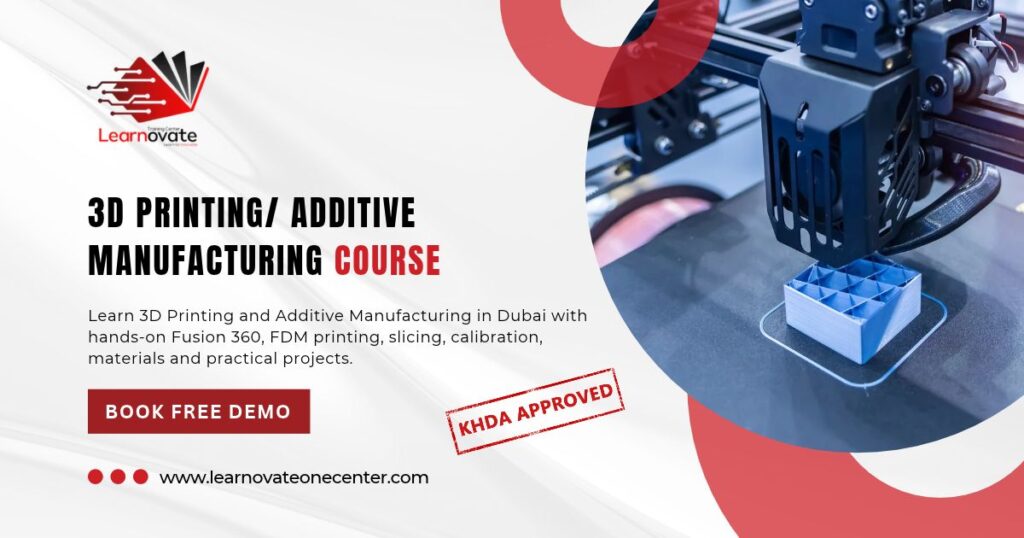
The 3D Printing and Additive Manufacturing Course in Dubai is designed to provide practical knowledge of the complete 3D printing workflow, from designing a 3D model to producing and finishing a physical printed component.
Participants learn how to create printable models using Autodesk Fusion 360, prepare STL and 3MF files, configure slicing software, select suitable materials, operate FDM 3D printers, calibrate printing equipment, troubleshoot common printing problems, and perform basic post-processing and maintenance.
The course combines theory with hands-on practical training and introduces both FDM/FFF and resin 3D printing technologies. Participants also complete practical projects to apply their 3D printing and additive manufacturing skills.
3D printing is used across engineering, architecture, product design, manufacturing, prototyping, and other technical applications. Learning 3D printing helps participants understand how digital designs can be converted into physical components using additive manufacturing technologies.
This 3D Printing Training in Dubai focuses on practical skills, including 3D modeling, print preparation, slicing, material selection, printer calibration, troubleshooting, and finishing.
Practical 3D Printing Training in Dubai
30-hour structured training
Beginner to professional learning level
Hands-on FDM/FFF 3D printing
Introduction to SLA and MSLA resin printing
3D modeling using Autodesk Fusion 360
Training with Cura, Bambu Studio or PrusaSlicer
3D printer setup and calibration
3D printing material selection
Printing parameter optimization
Troubleshooting and quality control
Post-processing and printer maintenance
Practical 3D printing projects
Final project and practical assessment
Additive manufacturing fundamentals
3D printing workflow: Design → Slice → Print
Applications in engineering, architecture and product design
Overview of industrial and desktop 3D printing
FDM and FFF printing
SLA and MSLA resin printing
Introduction to SLS and other industrial technologies
Selecting the appropriate printing technology
Printer frame, axes and motion system
Extruder, hotend, nozzle and build plate
Filament feeding and spool setup
Printer controls and basic machine configuration
Learn the fundamentals of 3D modeling with Autodesk Fusion 360 and understand how to create models suitable for 3D printing.
Fusion 360 interface and project setup
Sketching, dimensions and constraints
Extrude, revolve, sweep and loft
Fillet, chamfer, shell, holes and patterns
Learn how to design components according to practical 3D printing requirements and improve models for successful printing.
Designing printable components
Wall thickness and minimum feature sizes
Tolerances and clearances
Overhangs, bridges and support considerations
Part orientation and design optimization
Understanding STL, 3MF and OBJ formats
Exporting models from Fusion 360
Mesh quality and resolution
Checking and repairing print geometry
Preparing CAD models for slicing
Develop practical knowledge of slicing software used to prepare 3D models for printing.
Introduction to Cura, Bambu Studio or PrusaSlicer
Printer and material profiles
Layer height and line width
Wall, top and bottom settings
Infill patterns and density
Support structures
Support angle and density
Normal and tree supports
Brim, skirt and raft
Optimizing orientation to reduce supports
Nozzle and bed temperatures
Print speed and travel settings
Retraction
Cooling settings
Quality versus printing time
Strength versus material consumption
PLA
PETG
ABS and ASA
TPU flexible filament
Introduction to nylon and composite materials
Material selection, handling and storage
Bed levelling
Z-offset and first-layer calibration
Filament loading and unloading
Starting and monitoring a print
Basic dimensional calibration
Learn how to identify and address common 3D printing defects and quality issues.
Poor bed adhesion
Warping and layer separation
Stringing and blobs
Under-extrusion and over-extrusion
Layer shifting
Support failures
Dimensional accuracy problems
Removing prints safely
Support removal
Sanding and surface finishing
Part assembly
Nozzle and build-plate cleaning
Routine printer maintenance
SLA and MSLA workflow
Resin printer setup
Supports and orientation
Washing and UV curing
Resin handling and safety
Participants apply their 3D printing and additive manufacturing knowledge through practical projects.
Project 1: Simple customized 3D object
Project 2: Functional mechanical component
Project 3: Assembly and fit-tolerance component
Final project: Design → STL/3MF → Slice → Print → Inspect → Finish
Practical assessment and project presentation
3D printing skills can help learners understand modern additive manufacturing processes and develop practical capabilities for creating physical prototypes and functional components.
The course provides exposure to 3D modeling, printer operation, material selection, slicing, calibration, troubleshooting, quality control, and finishing. The practical project work also allows participants to apply their knowledge through a complete design-to-print process.
This 3D Printing Course in Dubai is suitable for learners who want to develop practical skills in 3D modeling, additive manufacturing, and 3D printer operation.
It can be suitable for:
Beginners interested in 3D printing
Engineering students and professionals
Architecture students and professionals
Product design learners
CAD users
Designers and makers
Manufacturing professionals
Anyone interested in additive manufacturing
Knowledge of 3D printing and additive manufacturing can support opportunities in areas such as:
3D Printing Technician
Additive Manufacturing Technician
3D Modeler
CAD Designer
Product Design
Prototype Development
Engineering Design
Manufacturing Support
3D Printing Operations
Learnovate provides practical, industry-focused training designed to help learners develop useful technical skills through structured learning and hands-on practice.
Practical and hands-on 3D printing training
Structured learning from fundamentals to practical projects
Training in 3D modeling and printing workflows
Focus on real-world applications
Beginner-friendly learning approach
Practical assessment and project work
Supportive learning environment
Training focused on applicable 3D printing skills
Build practical skills in 3D printing, additive manufacturing, 3D modeling, slicing, printer operation, calibration, and troubleshooting with Learnovate’s 3D Printing and Additive Manufacturing Course in Dubai.
Enroll today and develop the practical skills needed to take a digital design from concept to a physical 3D-printed component.
A 3D Printing and Additive Manufacturing Course teaches the complete process of creating digital 3D models, preparing them for printing, operating 3D printers, selecting materials, troubleshooting printing issues, and finishing printed components.
Yes. The course is designed for beginner to professional-level learners and starts with the fundamentals of 3D printing before progressing to modeling, slicing, printer operation, calibration, troubleshooting, and practical projects.
The course uses Autodesk Fusion 360 for 3D modeling along with Cura, Bambu Studio or PrusaSlicer for preparing models for 3D printing.
The course primarily focuses on FDM/FFF printing and also introduces SLA, MSLA, SLS and other industrial 3D printing technologies.
The course covers PLA, PETG, ABS, ASA and TPU, with an introduction to nylon and composite materials.